

TL;DR: Most start-ups fail not from poor execution or lack of passion, but from solving problems nobody cares about. The founder’s triad (Passion, Execution, Demand) creates three danger zones when you’re missing one element, but only missing demand is fatal. Before building anything, validate that people will actually pay for it; passion without demand is just an expensive hobby.
If you know a founder deep in build mode who hasn't fully validated demand yet, feel free to pass this on. The triad scoring exercise near the end is worth five honest minutes. Thank you :)
“Build it and they will come” might be the most expensive lie in tech.
I’ve watched brilliant engineers build flawless products nobody wanted. I’ve seen passionate founders pour their souls into solutions for problems that didn’t exist. And I’ve witnessed “boring” businesses print money because they simply filled an obvious gap.
The difference between them? They understood the hierarchy wrong.
We’re taught the formula is Passion + Hard Work = Success. But after two decades in product development and transformation, I’d argue it’s more like baking the world’s most perfect cake for a room full of people on a diet. You can have the finest ingredients (Passion) and flawless technique (Execution), but if nobody wants cake (Demand), you've just baked a very expensive cake that nobody's eating.
The Beautiful Lie We Tell Ourselves
Having worked across enterprise transformation and start-up advisory, I’ve noticed a pattern. The most talented builders: brilliant engineers, visionary product people, passionate founders etc., often fail not because they can’t execute, but because they’re solving a problem nobody else cares about.
They’ve got two-thirds of the equation sorted: Passion (the fuel that keeps them going) and Execution (the vehicle to get there). But they’re missing the only bit that actually matters: Demand (having somewhere people actually need to go).
All that horsepower means nothing if the journey itself is pointless.
Mapping the Danger Zones
I’ve started sketching this as a Venn diagram (cringe 😅, I know, but it helps). Here’s what each intersection actually looks like in practice:
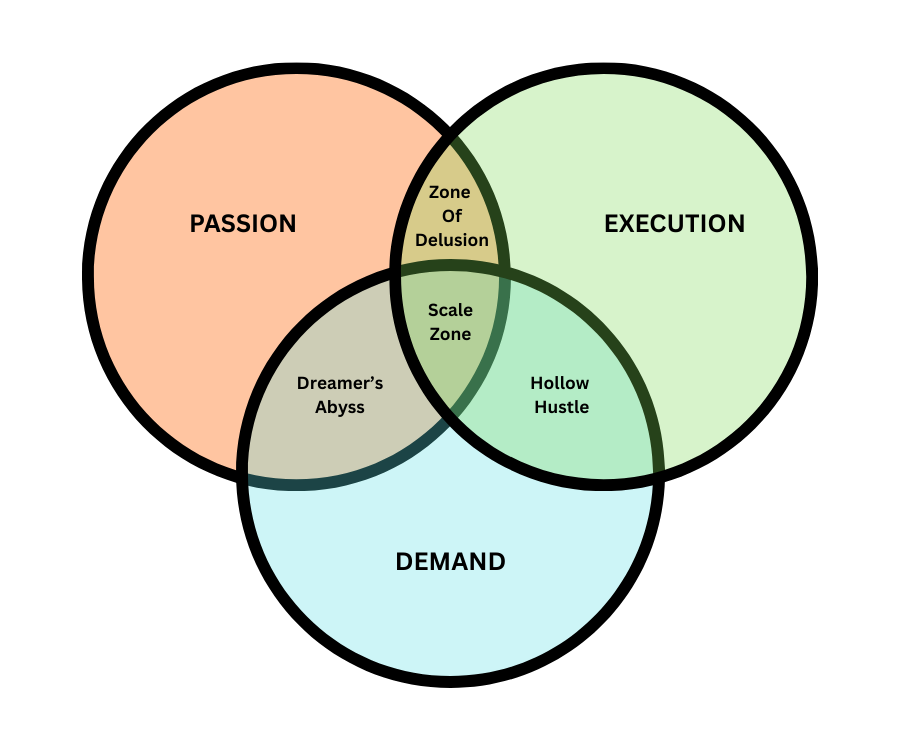
The Zone of Delusion (Passion + Execution - Demand) This is where I see most technical founders land. They build beautiful, functional products that solve problems nobody’s losing sleep over. I watched a team spend 18 months perfecting a platform that had zero product-market fit.
The Hollow Hustle (Execution + Demand - Passion) Viable but soul-destroying. You’ve found a gap, you’re filling it efficiently, but you hate Mondays. I’ve seen founders here either burn out or sell quickly. It’s profitable but unsustainable.
The Dreamer’s Abyss (Demand + Passion - Execution) The “idea person” trap. They’ve identified a real problem, care deeply about solving it, but lack the operational chops to deliver. They watch competitors succeed in the market they spotted first.
(And yes, there’s the sweet spot where all three overlap, but let’s call that the “Scale Zone”, not the starting point.)
What This Means for Building Products
After leading product teams through platform selections and watching start-ups navigate these waters, I’ve noticed successful teams validate in this order:
Demand First: Validation over Vision Don’t ask “Do you like this?” Ask “Are you currently trying to hack together a solution for this?” You don’t need them to design the solution for you. You just need proof that the problem hurts enough to pay for.
Execution Second: Viability check It’s not just about whether you can build it, but whether you can build it profitably.
Passion Last: The Sustainability Engine Stop treating passion as the starting point. It's the thing that keeps you going once demand has given you a reason to. Start with a problem. When you solve it, the customer gratitude provides the energy you need to keep going. That's how you avoid the "Hollow Hustle”.
This might sound backwards to the “follow your passion” crowd, but I’d argue that nothing generates passion faster than seeing real humans benefit from something you’ve built to solve real problems.
The Enterprise Parallel
Interestingly, this plays out in big corporates too. Having led multiple platform selections in enterprise environments, the vendors who won weren’t the ones most passionate about their domain or with the slickest tech. They were the ones who understood the core problem we were trying to solve: getting tens of thousands of employees across multiple countries to actually adopt new ways of working, not just access new software.
The best execution and passion means nothing if you’re solving a problem that doesn’t exist at scale.
Putting It Into Practice
Look, I’m not saying passion doesn’t matter. It absolutely does. It’s what gets you through the 2am debugging sessions and the twentieth investor rejection.
But passion without demand is just an expensive hobby.
Next time you’re evaluating an idea (whether it’s a start-up, a new product feature, or an enterprise platform), try this: Score each element out of 10: Passion, Execution, Demand.
(Pro tip: A 10 for Demand isn’t a gut feeling. It’s a Letter of Intent, a pre-order, or a waitlist of strangers. Be honest with yourself.)
If Demand isn’t your highest score, pause and reflect.
Because the market doesn't care how much you love your product. It only cares whether it needs it.
Which element of the triad are you over-indexing on? I’d love your thoughts, especially if you think I’m completely wrong about this. 😊
~ Pete G